
After giving you all so much good news, eventually one of my updates was going to be a bit of a downer.
I heard back from one of the agents I pitched to at the last conference—this was the agent who had requested the full manuscript of Veritas—and she decided to pass on Veritas. While I’m disappointed, I am an optimist at heart, so this just means that she wasn’t the perfect champion of Veritas that I’m looking for.
The point of this blog is that I want to be able to show you guys what this process looks like (the good and the bad), so below I have her email to me. I’ve redacted a bit of it. I don’t necessarily want to call her or her agency out—and one thing mentioned at the end is a bit of a spoiler. But after you read it, I want to talk through some of it.
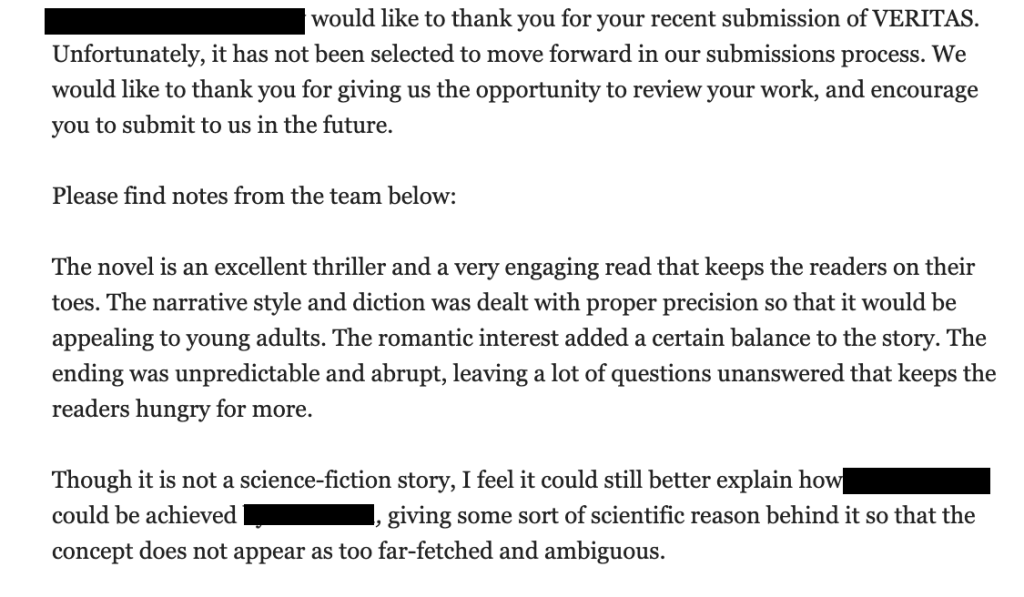
So first off, this email reads a little differently than past agents rejections I’ve received. It almost appears to have been written from the POV of the literary agency, as opposed to the agent I pitched to. The “notes from the team” almost feels like someone else read it, not necessarily the agent.
The most frustrating part is that overall, the feedback is incredibly positive, and the one suggestion they have would be a fairly easy fix. (It’s also a fair note. I am not a scientist, so I’m not surprised that the fictional science element could use a little work.)
In a perfect world, there would be some kind of explanation as to why the agent doesn’t feel that it’s a good fit—and why it’s not working for them. Either they didn’t connect with the characters, the plot wasn’t quite their speed, the pacing felt off, etc. But this feedback doesn’t necessarily say any of that.
I’m glad they had a lot of positive things to say about it, but it falls a little flat when it’s not accompanied by better reasoning as to why they ultimately passed. I find myself thinking, “If you thought it was so good, why don’t you want to represent it?” As a pathological people pleaser (in the words of my girl T.Swift), I also find myself wanting to fix what’s wrong. If they didn’t like it, what can I do better to ensure the next person will?
But unfortunately, that’s the nature of this business. I’m not always going to get the answers I’m looking for, and it would be incredibly unprofessional of me to email her back and ask for more specific feedback. Once an agent has said, “No,” that signals the end of that string of communication. In fact, you don’t even need to reply with a simple: “Thank you.” (This goes against every Midwestern politeness bone in my body.) They would prefer you don’t respond at all.
As I mentioned, I’m an optimist, but rejection (no matter what form it takes) always stings a little. However, I can’t let this one email derail the writing momentum I’ve been experiencing this year. I have to take this rejection and let it spur me onward; I have to focus on the compliments they gave my story.
One of the techniques I learned from the “Rejection” panel I went to was to turn rejection emails into blackout poetry. You make the rejection sound worse than it was, but in a funny way. I had a blast trying to parse out pieces of the rejection to include, and I hope this makes you laugh as much as I did! It was more cathartic than I expected it to be.
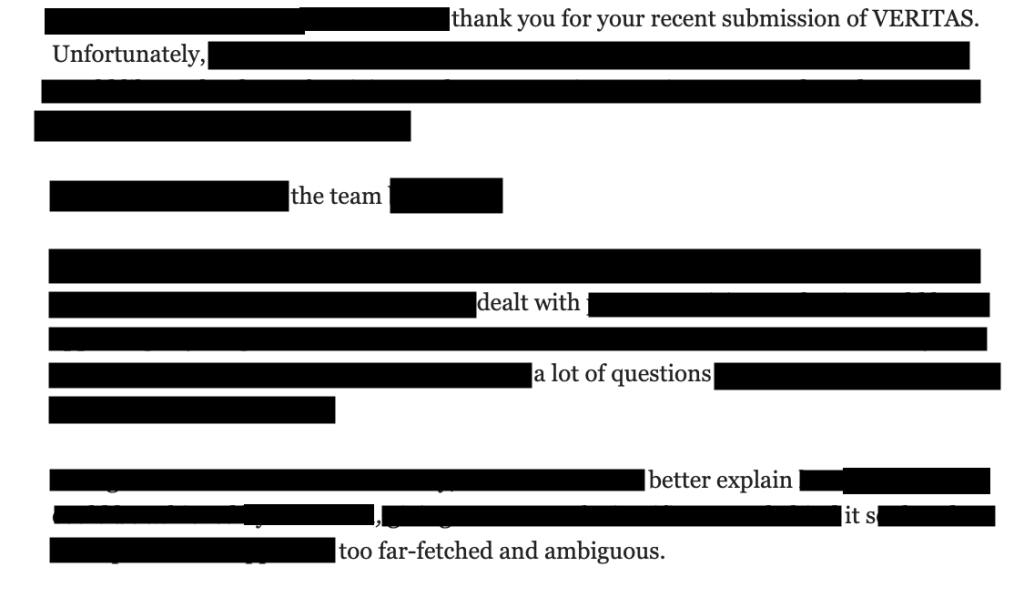
With this being the first rejection you have experienced with me, I hope you don’t feel too disappointed on my behalf. Even after I get a literary agent, the rejection will still come from editors, publishers, readers. This type of rejection comes with the profession, and each rejection just brings me one step closer to my goals. This email puts me one step closer to the agent who will want to represent me.
However, if you’re feeling creative this week (and made it this far in the blog post), you should try some blackout poetry of your own! I challenge you to see if you can make a funnier rejection letter than I did and send it to me.


Looks like they loved everything but the ending..
lots of positives to focus on!!!!
🧡🧡🧡
<
div>
Sent from my iPad
<
div dir=”ltr”>
<
blockquote type=”cite”>
LikeLike