
Well, well, well.
I told you there would be many parts to this series.
Currently, since I’ve restarted pitching in 2024, I’ve pitched to a total of 23 agents. (My total count since I first started querying in 2018 is 70.)
Actually, let’s go over some of my current 2024 query stats.
Agents Pitched: 24
Confirmed Rejections: 10
No Response, Assumed Rejection: 2
Waiting to Hear From: 12
I’m not much of a math girlie, but I know that those stats aren’t awesome. However, that’s the nature of the business. As disappointing as it is, the rejections I want to talk about today are a good example of something I haven’t talked about on this blog yet–form rejections.
Literary agents get hundreds of queries every single day, and I don’t know about you, but I don’t have time to personally respond to that many emails every day. So on one hand, I see why sometimes they don’t respond at all. In my own line of work, my inbox tends to average 100-150 emails a day. (In fact, when I took time off a couple weeks ago, I came back to 340 emails.) Granted, I don’t have to respond to all of those, but I’ve definitely had days where I feel like almost all of my day has consisted of responding to emails (and a fair amount of problem solving). So I can definitely see how that would be overwhelming to try to provide feedback to every single person who queries.
Honestly, I’d much rather get a form email rather than no response. At least that way I’m not wondering if my manuscript is still on the table for them or not. I have a place on my agent spreadsheet to denote how long it should take to hear from them, that way I’ll know if I haven’t heard back in 12 weeks that it’s a “No thanks.”
Below are examples of what these types of rejections look like. Some of them call out the fact that it’s a form letter, and others, you can tell that all they did was swap out the author’s name and the manuscript title.
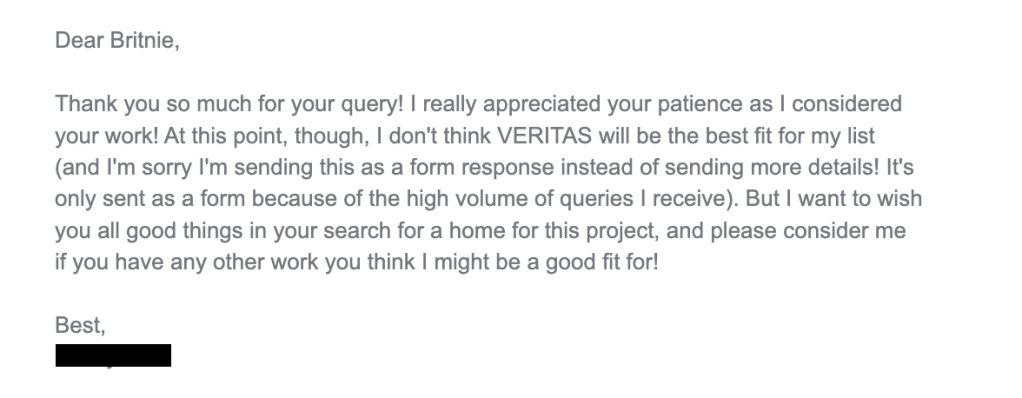


Seven of the rejections I’ve received have been form rejections, and while that might seem like a lot, it’s more common to receive a form rejection after querying. If an agent requests more of the manuscript (such as two of the agents I pitched to at the writing conference), and then rejects it, that’s usually when you get a little bit more feedback as to why your manuscript isn’t a good fit for them. (But as we’ve established, the feedback isn’t always helpful.)
Some of the advice given at the second writing conference I attended was that if you aren’t getting requests to read more, you may need to rework your query letter. If you’re getting requests for more pages, but not offers of representation, then your writing needs some work. With the number of rejections I’ve been receiving from just the query letter (and I haven’t been getting requests for more pages), I think it may be time to rework my query letter. Or I need to find a freelancer online who does query critiques and see what kind of query feedback they have.
Now that I’m trying to get back in the writing groove again (summer really threw me off), the plan is to research and query agents more frequently!
 Britnie Jenkins
Hi Britnie, Thanks for sharing about the process. It’s really interesting as well as complicated with a lot of pieces and parts of “how it all works”. I had no idea and I’ve learned a lot! Seems like a hard line of work and there will be way more no’s than yes’s. Hang
LikeLike